01-05-2026
How Vertical Hospitals Are Transforming Healthcare Architecture in India Ravideep Singh
How Vertical Hospitals Are Transforming Healthcare Architecture in India
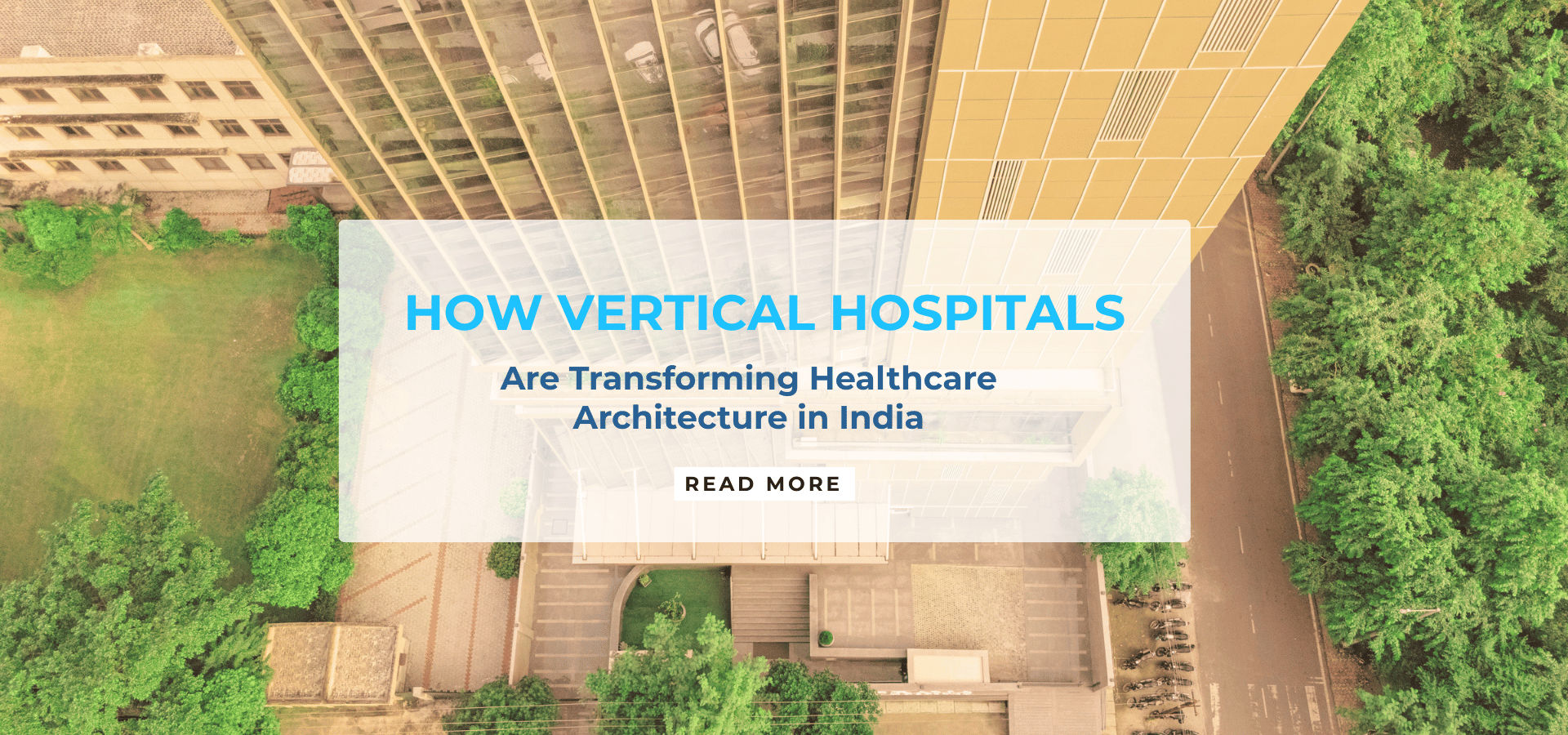
India's urban centres are expanding, but the land available for development is not. Across cities like Delhi NCR, Mumbai, and Bengaluru, healthcare infrastructure is increasingly being inserted into dense, high-value urban parcels where horizontal growth is limited. As a result, hospitals are shifting away from low-rise, campus-style developments toward vertical systems, stacked and calibrated to operate efficiently within constrained footprints. This shift reflects broader healthcare design trends and evolving hospital planning guidelines in India, where verticality is becoming central to the design of large-scale facilities.
From Horizontal Campuses to Vertical Systems
Traditionally, hospitals in India were designed as expansive campuses, with functions spread across multiple blocks connected by corridors and open spaces. This model allowed for clear zoning and relatively simple circulation patterns. In dense urban contexts, however, such horizontal expansion becomes increasingly difficult to sustain.
While this vertical shift is most visible in metropolitan cities, similar pressures are emerging in tier-2 and tier-3 urban centres. As cities densify, traditional hospital layout design approaches are being re-evaluated, with vertical planning emerging as a critical response to spatial and operational constraints. Planning for vertical healthcare infrastructure at this stage enables long-term adaptability, ensuring that hospitals remain accessible and operationally efficient as urban conditions evolve.
Vertical hospitals must accommodate the same range of functions, aligned with evolving hospital design guidelines, including outpatient department (OPD) design, critical care, and surgical planning, within a limited footprint. This requires a rethinking of spatial hierarchy. Public and high-footfall areas should be placed at lower levels for ease of access; surgical and critical care zones positioned centrally for efficiency; and inpatient wards above, offering quieter, more controlled environments for recovery.
Circulation as Infrastructure
As buildings grow taller, movement becomes more complex. In vertical hospitals, circulation becomes part of the infrastructure, shaped by factors to be considered in hospital planning, such as efficiency, safety, and controlled movement. Ramps and vertical cores must handle high patient volumes and services without overlap or delay.
Segregation of movement is critical. Separate systems for public access, clinical staff, emergency movement, and service logistics ensure that each operates without interference from the others. The speed and distribution of elevators become central to the hospital's performance. Poorly planned vertical circulation leads to congestion, delayed response times, and increased operational stress. In contrast, a well-resolved system allows the building to function seamlessly despite its density.
The Unit-Aggregate Approach
One response to vertical complexity is the emergence of unit-aggregate planning. Instead of organising hospitals as large, centralised systems, functions are grouped into smaller, self-sufficient care units. Each unit integrates consultation, diagnostics, treatment, and recovery within a defined zone, reducing the need for long-distance movement across the building.
In vertical formats, this approach becomes particularly effective. It allows care to be delivered within compact clusters, limiting dependency on elevators and minimising patient transfers across levels. Patients move within a more contained environment, and the building operates through parallel systems rather than bottlenecks. This approach also addresses common challenges in hospital design, particularly those related to movement, scale, and operational complexity.
Daylight, Orientation, and the Human Experience
One challenge in vertical healthcare environments is maintaining spatial clarity and comfort. As buildings grow taller and denser, there is a risk of creating deep, artificially lit interiors that feel disorienting and clinical. To counter this, planning strategies must integrate daylight as an organising element.
Circulation spines and key transition zones should be aligned along naturally lit edges wherever possible. Atria and internal courtyards can introduce light into the building's core, breaking down scale and providing visual anchors. These interventions support wayfinding and create more legible, humane environments, directly enhancing the patient experience in hospital design.
Environmental Response in Vertical Form
Vertical hospitals also demand a more nuanced environmental strategy. Facade design becomes critical in balancing daylight and heat gain across multiple orientations. Shading devices, high-performance glazing, and material selection must respond to changing sun angles at different heights.
Terraces and landscaped inserts play a dual role, moderating microclimate while introducing moments of pause within the clinical environment. In dense areas, these become essential in maintaining a connection to light and landscape. Sustainability, in this context, becomes embedded through planning and envelope design rather than applied as an afterthought. These strategies align with emerging models of smart hospital design, where performance, environment, and technology operate together.
Designing for Density
Verticality is often seen as a constraint. In healthcare architecture, it can become an opportunity. When approached with planning intelligence, vertical hospitals can achieve high capacity without compromising on efficiency or patient experience. They allow healthcare infrastructure to exist within cities rather than at their edges, improving access and reducing travel time for large populations.
At CDA, this approach to vertical healthcare planning is explored across multiple urban projects where constrained sites demand high-performance design responses. We developed the Rama Hospital in Noida as a vertically organised prototype within a compact footprint. The project structures clinical functions through a clear sectional hierarchy, integrates segregated circulation systems, and enables operational efficiency within limited space. By adapting an existing structural shell and aligning spatial planning with environmental strategies, it aims to demonstrate how verticality can support clinical performance and experience in dense urban contexts.
Towards a New Urban Healthcare Model
As Indian cities continue to densify, vertical healthcare will become less of an exception and more of a norm. This shift calls for a redefinition of how hospitals are conceived, not as isolated buildings, but as integrated systems within the urban fabric. Understanding how to design a hospital in today's context demands a shift toward integrated, system-led thinking. When guided by intent, verticality has the potential to reshape healthcare delivery in Indian cities, creating responsive, future-ready environments.